Diagnosed with a herniated disc or protrusion? Back pain affecting your daily life? At the Healthy Spine Center, we work with disc herniation without surgery — through kinesiotherapy and wellness gymnastics, restoring mobility and relieving pain.
Book a Consultation
A herniation is not a verdict. And it's definitely not the cause of your pain on its own. Yes, it's a bulging disc. But here's what's important to understand: the herniation itself is a consequence, not a cause.
The problem doesn't start in the disc. It starts in the muscles. When muscles: — lose strength — become stiff — stop working properly they stop nourishing the spine. The disc no longer gets enough nutrition, loses elasticity, and starts to break down. Only then does a herniation appear.
Because they don't work with the cause. Injections, pills, blocks — these are attempts to remove the symptom. But: — the muscles stay weak — movement is disrupted — the load is distributed incorrectly And the problem comes back. Again and again.
Not rest. Not a ban on movement. But correct movement. When exercises: — without axial load — with technique control — with a gradual activation of muscles the body starts to recover. The spasm goes away. Pressure decreases. Mobility returns.
At the Healthy Spine Center we don't fight a 'herniation'. We work with the cause.
A herniation on an MRI doesn't always hurt. Pay attention if you notice:
Aching or sharp pain that gets worse when bending, sitting for long or lifting heavy things.
Shooting pain through the buttock and leg, or into the arm with a herniation in the neck.
Pins and needles or numb patches in the foot, toes or fingers.
It's hard to straighten up after sleep; moving takes effort.
The body leans to one side, and you want to bend over to ease the pain.
A sharp jolt in the back when coughing, sneezing or straining.
Increasing leg weakness, numbness in the groin area, or bladder or bowel problems — see a doctor urgently.
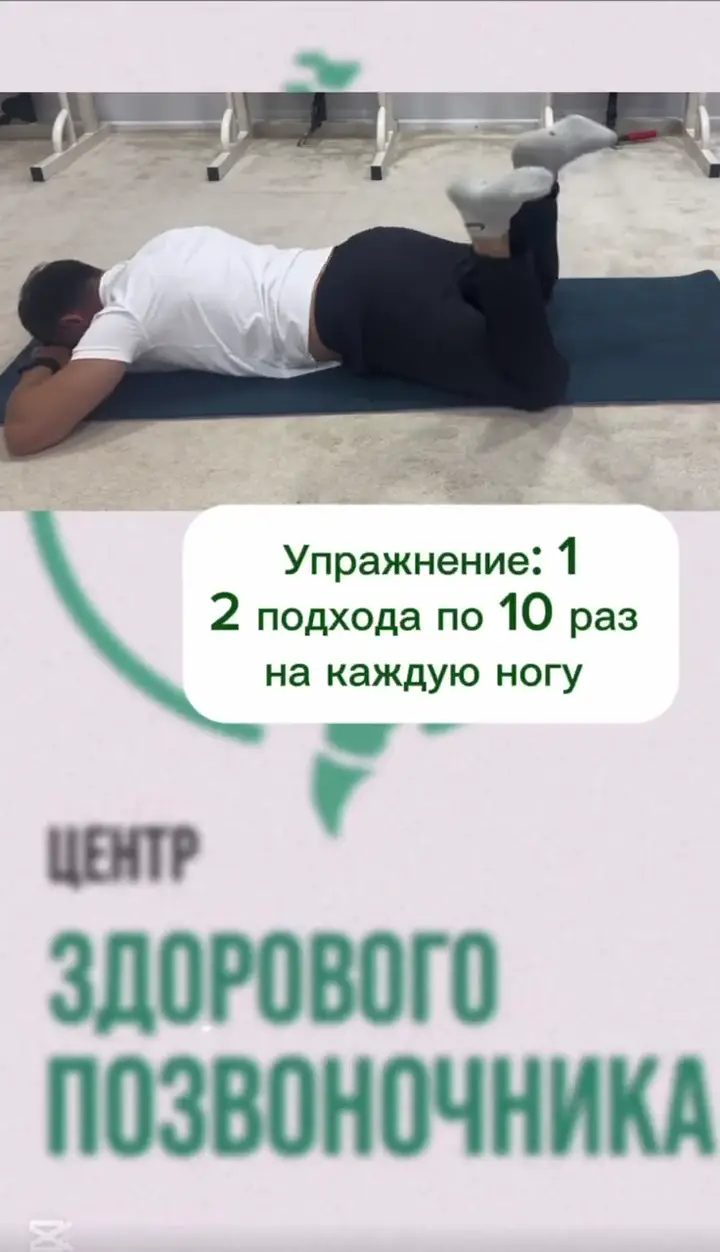
A short routine on a mat: relieves tension and improves the mobility of the spine and hip joints. Most exercises are 2 sets of 10 reps on each side, slowly and without pain.
Lying face down with your forehead on your hands, bend your legs at the knee one at a time. Then do the same with a band around the ankles — 3 sets of 10–15 reps. Activates the hamstrings and glutes.
Lying face down, bend one leg and slide the knee out to the side along the mat, then bring it back. Restores hip joint mobility.
Kneeling on one knee with a hand behind your head, rotate your torso toward the front leg. Gently opens the upper back and relieves tension in the back.
From a lunge with hands on the mat, rotate the pelvis and lower yourself onto your hip, then return. Improves pelvis and hip joint mobility.
With a herniated disc, the load is chosen individually: if the pain is acute or radiates to the leg, start only after an assessment. Do every exercise without pain.
Briefly about the causes and what to do
Why discs lose nourishment and what muscle function has to do with it.
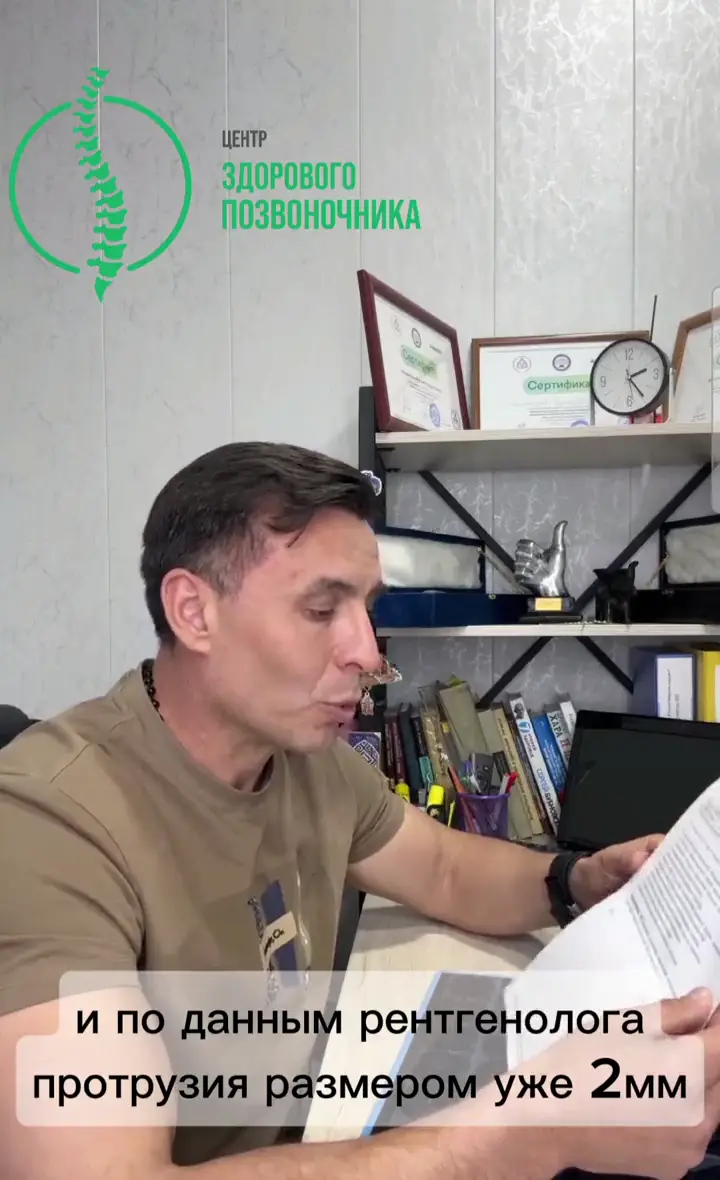
Protrusions occur even in teenagers. We explain why this happens and what to do.
Little movement, long hours at a desk and with gadgets — why herniations appear even in teenagers.
Why pills and injections give a temporary effect and why it matters to work with the cause of pain.
On April 25 I came with a diagnosis of a sequestered L5S1 herniation measuring 10*18*13 mm. I was limping, my foot was completely numb, I couldn't move my toes… After the first session the numbness remained only in my big toe, and after the 4th session I got behind the wheel and drove to the sessions myself from Sergeli. I completed 30 sessions to fully consolidate the result.
A month and a half ago I lived in constant pain. A herniated disc, unable to move normally — I couldn't sit, stand or walk… But after the fourth session I already felt relief, and then more and more. With every session the pain was going away… lightness in movement appeared, my energy came back, and I felt like a whole person again.
A consultation, review of your MRI and other test results, myofascial diagnostics and functional tests. We find which muscles aren't working and are overloading the disc.
Wellness gymnastics or kinesiotherapy on special decompression equipment — without axial load on the spine.
The basic course is 20 sessions in the kinesiotherapy hall or 30 sessions of wellness gymnastics. The instructor monitors your technique, and we adjust the load based on how you feel and your progress.
We give you home exercises and recommendations to keep the result after the course.
Leave a request and we will contact you to confirm your appointment and answer all your questions.
Two centers in Tashkent — choose the one convenient for you